It's still the time of the Covid-19 pandemic. I'm aware you, reader, probably know that but I'm saying that for the benefit of someone who might be reading this in some future time when this is all over. Assuming that happens.

One of my first thoughts after the lockdown started was of Edgar Allan Poe's short story The Masque of the Red Death. It's about a group of rich people who lock themselves up in a castle so that they can party while the peasants outside are dying of the plague.
This might remind one of certain footballers.
There's lots of comics adaptations of this story but I can recommend the one by Richard Corben from 2013 (published as The Raven and The Red Death by Dark Horse).

Anyway, like many other people, I have used some of my lock-down time to catch up on some things I've missed and revisit some old favourites.

For example, I have read The Wild Storm from 2017 by Warren Ellis and Jon Davis-Hunt and this panel struck me as sad.

(And I hasten to point out this was before I knew what we now know about Ellis)
I've also been rereading Neil Gaiman's groundbreaking Sandman (1989) (on and off) and had forgotten that that starts with a worldwide "sleepy sickness" that baffles doctors (spoiler: it's a supernatural cause).

I had The Wilds by Vita Ayala and Emily Pearson (2018) recommended some time ago so I gave it a go.

Yep, it's about a worldwide disease. A bacterium that slowly turns people into plant-like organisms after becoming rage-induced "zombies".

It's good, too. We see the lives of the survivors and the specialist jobs of those with the skills to hunt for supplies. The plant-based plague makes for some very interesting visuals.

But there were plenty of things to draw parallels with our current situation. The importance of masks, for example.

All right, so we have ourselves a theme. Viral outbreaks. Let's take a look at some comics where they happen.

A virus (or a bacterium) is invisible. So how does one show it in a visual medium?

...Okay, that's one way.
The more usual way is to show it's effects on a group of people.
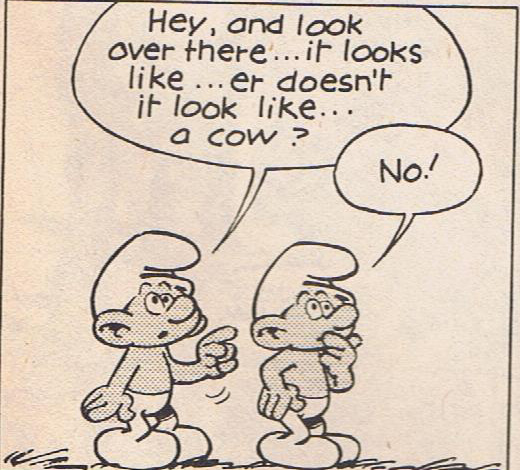
Or smurfs.
We have covered the history of those little blues gits before (click here for smurfin' more!) and mentioned their viral outbreak in their first solo story, Les Schtroumpfs Noirs (or in it's anglicised, pallet-swapped reprint Purple Smurfs, 1963) by Peyo there. But to reinforce for our purposes today we will notice that the virus crosses over from animal (a fly) to smurf.

We see that the virus can be passed from Smurf to Smurf by contact. Well, biting.

And it's left for Papa Smurf to develop the vaccine, administered by bellows.
I did comment on my previous post just how much this story resembles a zombie outbreak (albeit years before Night of the Living Dead) so let's briefly mention zombies.

Zombie comics have become their own mighty sub-genre, thanks largely to the all-conquering The Walking Dead by Robert Kirkman, Tony Moore and Charlie Adlard (2003-2019).

But zombies are undoubtedly their own category, to be covered another time.

However, my favourite mass-extinction comic story (and everyone should have at least one) is Brian K Vaughn and Pia Guerra's Y: The Last Man.

A tale of a world where every male mammal, apart from the titular Yorick and his monkey Ampersand, died instantly from an unknown disease. I won't spoil any of it here but I do recommend it.

Skipping to a different kind of comics, Daniel Clowes' David Boring (2000, originally serialised in Eightball) features a sequence where the eponymous David is led to believe that germ warfare has struck the mainland and he's forced into quarantine in a house on an island with a group of (mainly) strangers.


Again, I won't spoil things.
On to the world of 2000AD now and a major outbreak of the virus 2T(fru)T (ahem) has driven a sizable portion of the residents of Mega City Two mad, at the start of the epic story The Cursed Earth (1978) by Pat Mills and Brian Bolland (among others).

The scientists of Mega City One have developed a vaccine and it's up to Dredd to deliver it.

In a later story, a virus carried on the weather drives the resident of Mega City One mad with Block mania! (1982)

And, reflecting the world of 2020, this doesn't stop the citizens from taking to the beaches...

To the world of superheroes now and perhaps the best outcome for a viral outbreak: SPIDER-POWERS!

Marvel's 2011 crossover Spider-Island (various writers and artists) event saw the residents of Manhattan mysteriously developing the proportional strength and agility of a spider! Plus, y'know, sticking to walls an' that.

Fortunately New York mayor J Jonah Jameson (yes, really) was the proper authoritarian leader they needed. Immediate lockdown and forced quarantine stopped the spread any further.

Say what you like about JJ, he was a strong leader in a time of crisis.

On now to Gotham City, which in the 1996 crossover Contagion (various writers and artists) was in the grip of the Clench!

An engineered airborne virus, by people working for R'as Al Ghul, was brought into Gotham by one of the city's rich elite and spreads rapidly.

Gotham's rich elite, however, believe they are safe in their climate-controlled towers.


Yep, we're back to the Red Death.
It will be interesting to see how this world-changing event is represented in comics in the future. It's already being addressed in some quarters.
(Six Chix, 2020)
Some newspaper comic strips (remarkably) were ahead of the curve on this. If you want to know more about how that field has adapted, you can read this article from Polygon by The Comics Curmudgeon, Josh Fuhrlinger.
On my first trip back to comic shop post-lockdown, I was surprised to find this exchange in one of the new batch of books I'd picked up from The Boys: Dear Becky by Garth Ennis and Darrick Robinson:

I imagine this was substituted in late for a different disease, but kudos to the editors for making a scene (following one set in a crowded Scottish pub) feel new.
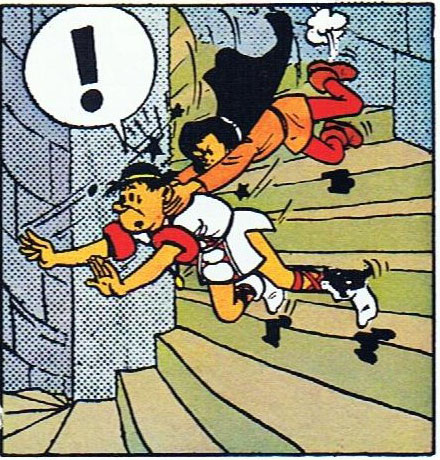
Some people were alarmed to find there was a character from a recent Asterix story (Asterix and the Chariot Race by Jean-Yves Ferri and Didier Conrad, 2017), a champion chariot racer whose name...

Yes, the word corona-virus may have only broke through to the mainstream with Covid-19 but it was a term in use well before. And the typical Asterix punning-name convention inevitably led to this.
The story itself is a Cannonball Run-style romp with Coronavirus as the favourite (he's cheating, natch).

That's all for now. If you know of any outbreaks I've missed, feel free to let me know in the comments and maybe I'll do another.
(I've just thought of the Legacy virus from X-Men, which was more of an AIDS allegory, so don't put that)